



If you want to know how to grow a construction business past £1M, here's the direct answer: the approach that got you to £1M will not get you to £3M or £5M. Most owners at your stage have the skills, the reputation, and steady work. What's missing is the right pricing structure, reliable systems, a predictable pipeline, and a team that can deliver without you holding everything together.
The question of how to grow a construction business at the £1M-plus stage isn't one of tactics. It's one of structure. The businesses that break through the £1M ceiling are typically strong across five areas: a clear growth plan, attracting the right clients, converting them at the right margin, delivering consistently, and building a structure that scales. The ones that stall are solid on one or two of those and weak on the rest.
Below are the seven specific mistakes that stop construction businesses at this stage. Each one is fixable. Work out which apply to your business and start there.
1. Poor Cash Flow Management
Revenue looks healthy on paper but the bank account tells a different story. This is the most common pressure point for construction businesses between £1M and £3M. You can invoice £600,000 in a quarter and still struggle to make payroll if the timing is wrong.
The problem isn't the size of your contracts. It's the gap between money going out (labour, materials, plant hire, subcontractors) and money coming in. A 60-day payment term from a client, combined with 30-day terms from your suppliers, creates a constant shortfall. Scale the business without fixing this and the cash gap scales with it.
How to fix it
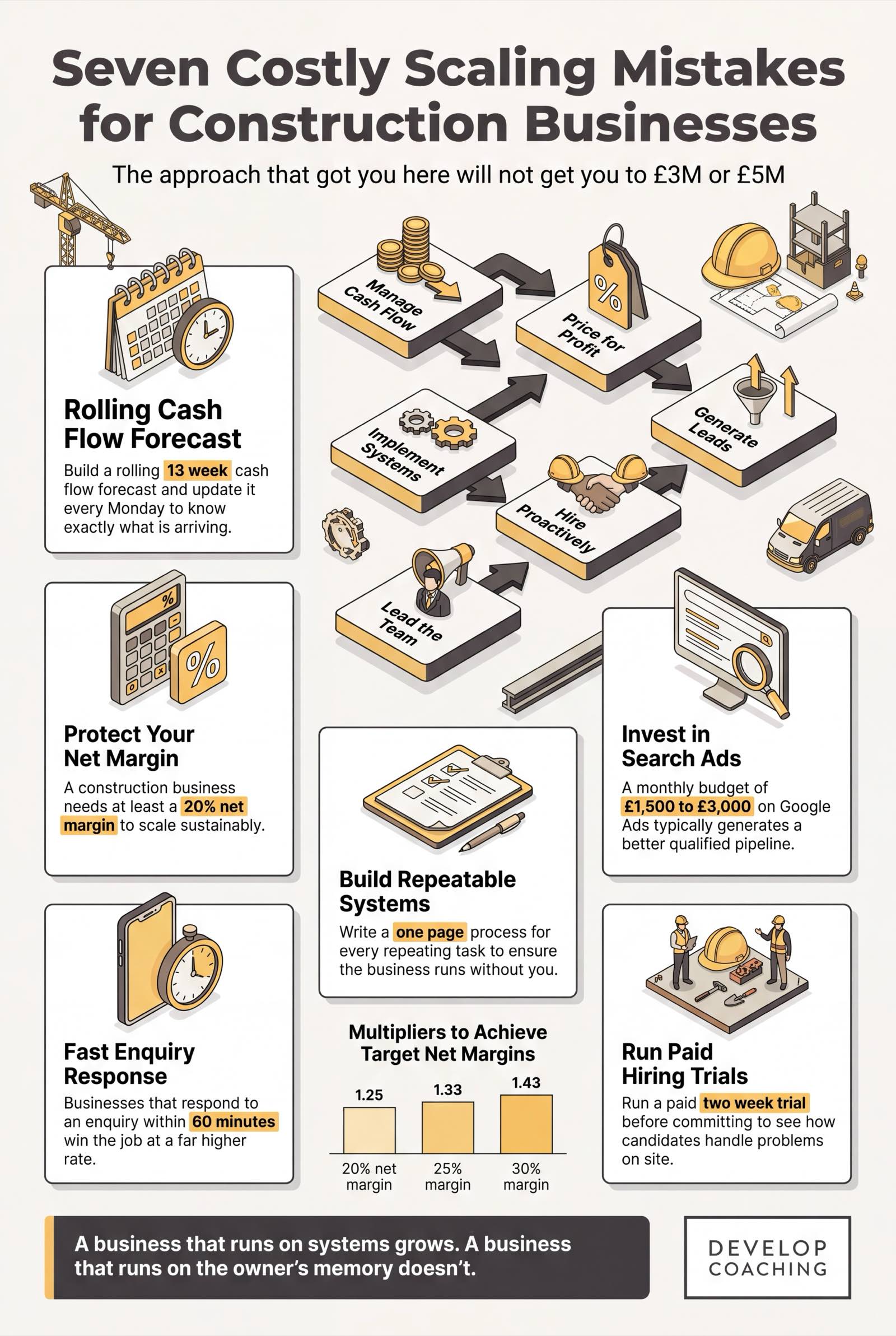
- Build a rolling 13-week cash flow forecast and update it every Monday. You should know exactly what's arriving and what's going out for the next three months, not just this week.
- Invoice at milestones, not at completion. Break every project into stages and raise an invoice when each one is done. A £250,000 job should generate invoices at groundworks, structure, first fix, second fix, and handover, not one bill at the end.
- Negotiate payment terms before you sign. Push for 14-day terms and ask for a 10 to 20% deposit upfront. Late payment fees should be written into every contract as standard, not bolted on after the fact.
- Track your work in progress (WIP) every week. Many construction businesses have cash sitting idle in half-finished jobs that haven't been invoiced. WIP reporting shows you where that money is.
For a full breakdown of this, read our guide to construction cash flow management for businesses scaling past £1M.
2. Underpricing Jobs and Ignoring Profit Margins
Underpricing is how construction businesses stay busy and go broke at the same time. If you're regularly winning jobs but not seeing strong net profit at year end, this is likely why.
Pricing by gut feel or by looking at what competitors charge doesn't work. Your competitors may be in the exact same trap. And gut feel doesn't account for the overheads that grow as the business grows.
How to fix it
Build your pricing from the ground up. Calculate direct costs first: labour, materials, plant, subcontractors. Then apply an overhead allocation. Then apply your target margin.
- If your annual overhead (office, vehicles, admin, your own salary, insurance, software) is £200,000 and you complete 12 projects a year, that's over £16,000 per project before you've ordered a single delivery. That figure goes into every quote.
- To hit a 20% net margin: multiply your total costs by 1.25.
- To hit a 25% margin: multiply by 1.33.
- To hit a 30% margin: multiply by 1.43.
A construction business needs at least a 20% net margin to scale sustainably. Below that, you're carrying significant risk for very little reward. If you're consistently losing jobs priced at a fair margin, the fix is better positioning and selling, not dropping your price. Chasing volume at thin margins is one of the fastest ways to grow a business that makes you less money the busier it gets.
3. No Systems or Standard Operating Procedures
A business that runs on systems grows. A business that runs on the owner's memory doesn't. If you're the only person who knows how to price a job, onboard a new client, or deal with a materials dispute, you are the bottleneck, and the business can only grow as fast as you can personally handle.
At the £1M to £2M stage, most owners are still carrying the business on their shoulders. Site managers do things their own way, estimators quote inconsistently, and every client gets a slightly different experience depending on who they speak to. That inconsistency is invisible to you but shows up in your results: rework, disputes, margin erosion, and staff who can't operate without constant direction.
How to fix it
- Document what good looks like. Write a one-page process for every repeating task: how to quote, how to onboard a client, how to run a site induction, how to close out a project. They don't need to be long. They need to be followed every time.
- Use project management software. Buildertrend, Procore, or a structured Asana setup gives you visibility across all live jobs, tracks costs against budget in real time, and cuts the number of calls you receive from site each day.
- Measure weekly, not monthly. Track percentage complete, cost to date versus budget, and invoiced versus actual on every live project. If a job is running 10% over budget at the halfway point, you need to know in week four, not week twelve.
Read more on building effective construction business systems that let the business run without you in the middle of every decision.
4. Failing to Generate Consistent Leads
Word of mouth is valuable. It's also unpredictable. When referrals slow down, so does the business, and owners end up taking whatever comes in regardless of margin or project type. That reactive cycle kills profitability and makes it almost impossible to be selective about the work you take on.
A construction business scaling from £1M to £5M needs a predictable flow of the right enquiries. Not every enquiry that comes through the door. The right ones: the right project size, the right client type, the right location.
How to fix it
- Get your Google Business Profile right. For most UK construction businesses, local search is the highest-converting channel available. A complete, regularly updated, well-reviewed profile puts you in front of people actively searching for your trade in your area. It costs nothing to maintain and consistently outperforms paid social for commercial intent.
- Run Google Ads on your key services. People searching for a contractor on Google have intent. They're ready to enquire. A well-managed campaign with a monthly budget of £1,500 to £3,000 typically generates a better-qualified pipeline than a similar spend on social media, because the intent is already there.
- Follow up within the hour. Businesses that respond to an enquiry within 60 minutes win the job at a far higher rate than those who call back the following day. Build a follow-up process into your operations, whether that's a CRM, a VA, or a dedicated admin person.
- Build proper case studies. A short write-up of a completed project, with photos, scope, timescales, and what the client said, converts far better than a generic five-star rating with no detail. Three good case studies will do more for your close rate than most marketing tactics.
For a structured approach to building a pipeline that doesn't rely on referrals, read our full guide to construction lead generation.
5. Hiring Reactively Instead of Proactively
The most expensive hire you'll ever make is the one you made in a panic. Reactive hiring means taking the first available person rather than the right one, overpaying to get them on site quickly, and skipping the proper induction because the project can't wait. None of that ends well.
At the £1M to £3M stage, team quality sets your ceiling. One poor site manager on a £300,000 project can wipe six months of net profit through rework, delays, and client complaints. The cost of a bad hire isn't just the person's wages. It's the damage they cause while they're there.
How to fix it
- Keep a job advert live at all times, even when you have no current vacancy. Good tradespeople look for new roles when they're ready, not when you need them. A live advert builds a pool of warm candidates before you're desperate.
- Use a hiring scorecard. Before you interview anyone, define the five things the role needs to do well. Score every candidate against those criteria before you meet them. It stops you hiring someone you liked over someone who will actually perform.
- Run a paid two-week trial before committing. Two weeks on a live project gives you far more useful information than any interview. You see how they work, how they communicate on site, and how they handle problems before you're depending on them.
See our guide to mastering construction hiring to build a team capable of delivering at scale.
6. Poor Leadership and Communication
When things go wrong on site, the instinct is to blame the team. More often it's a leadership problem. If your expectations aren't clearly set, your team can't meet them. If performance isn't reviewed, poor performance continues unchallenged. If site managers aren't running consistent briefings, mistakes compound across the whole project.
Scaling a construction business means stepping back from doing the work and into leading the people who do it. That's a genuinely different skill set, and most construction owners never formally develop it because nobody teaches it on the tools.
How to fix it
- Run a weekly operations meeting. Thirty minutes with your key people. Cover what's on that week, what's at risk, and what needs a decision. Consistency matters more than how long it runs.
- Give every role a clear KPI. Not just site staff. Your estimator, your project manager, your admin. Everyone has a number they're responsible for. If they don't know their number, they're working without direction.
- Coach, don't just manage. When something goes wrong, ask what process failed and how you stop it happening again. That approach builds a team that surfaces problems early rather than hides them until they're expensive.
7. Not Investing in Your Own Development
This is the one most owners skip, and it's the one that unlocks everything else. Every practical problem on this list has a known solution. Applying those solutions requires the owner to learn skills they've never been formally taught. Pricing strategy, leadership, sales, financial management. These aren't taught on site. The business won't outgrow the owner until the owner grows first.
The construction business owners who break through to £3M and £5M aren't smarter or better builders. They invest in themselves. They work with coaches, study their numbers, join peer groups, and implement what they learn. The owners who stay at £1M keep doing what they know and wonder why nothing changes.
How to fix it
- Work with a business coach who understands construction. Not a generalist. Someone who has worked specifically with trade-based businesses at your stage and understands the dynamics. Good coaching, properly implemented, returns hundreds of thousands, not thousands.
- Join a peer group or mastermind. Being in a room with other construction business owners at your level is one of the fastest ways to solve problems you've been sitting with for months. Someone else has already made the mistake you're about to make, and they can tell you exactly how it went.
- Protect time to work on the business. One half-day per week for planning, reviewing your numbers, and improving your systems. It feels unproductive until the day it isn't.
What It Actually Takes to Grow a Construction Business
There's no single lever to pull. Sustainable growth at the £1M-plus level comes from several things working together: cash flow you can see clearly, pricing that protects your margins, systems that don't depend on you personally, a consistent flow of the right enquiries, a team built carefully rather than reactively, clear leadership, and the commitment to keep developing as the owner of the business.
Most of your competitors aren't doing all of these consistently. Get solid on three or four of them and you're already operating differently to the majority of the market. Build all seven and growth stops being a scramble and starts being a repeatable process.
Ready to Scale Your Construction Business?
Develop Coaching works exclusively with construction business owners at the £1M to £5M stage. We've helped contractors fix the exact issues in this article, from pricing and cash flow to systems, hiring, and leadership, and build businesses that scale without the owner in the middle of everything.
If you want a clear view of which of these seven areas is your biggest constraint right now, and a practical plan to fix it, apply for a free strategy call. We'll look at your business specifically, tell you honestly where the gaps are, and give you a clear starting point.