


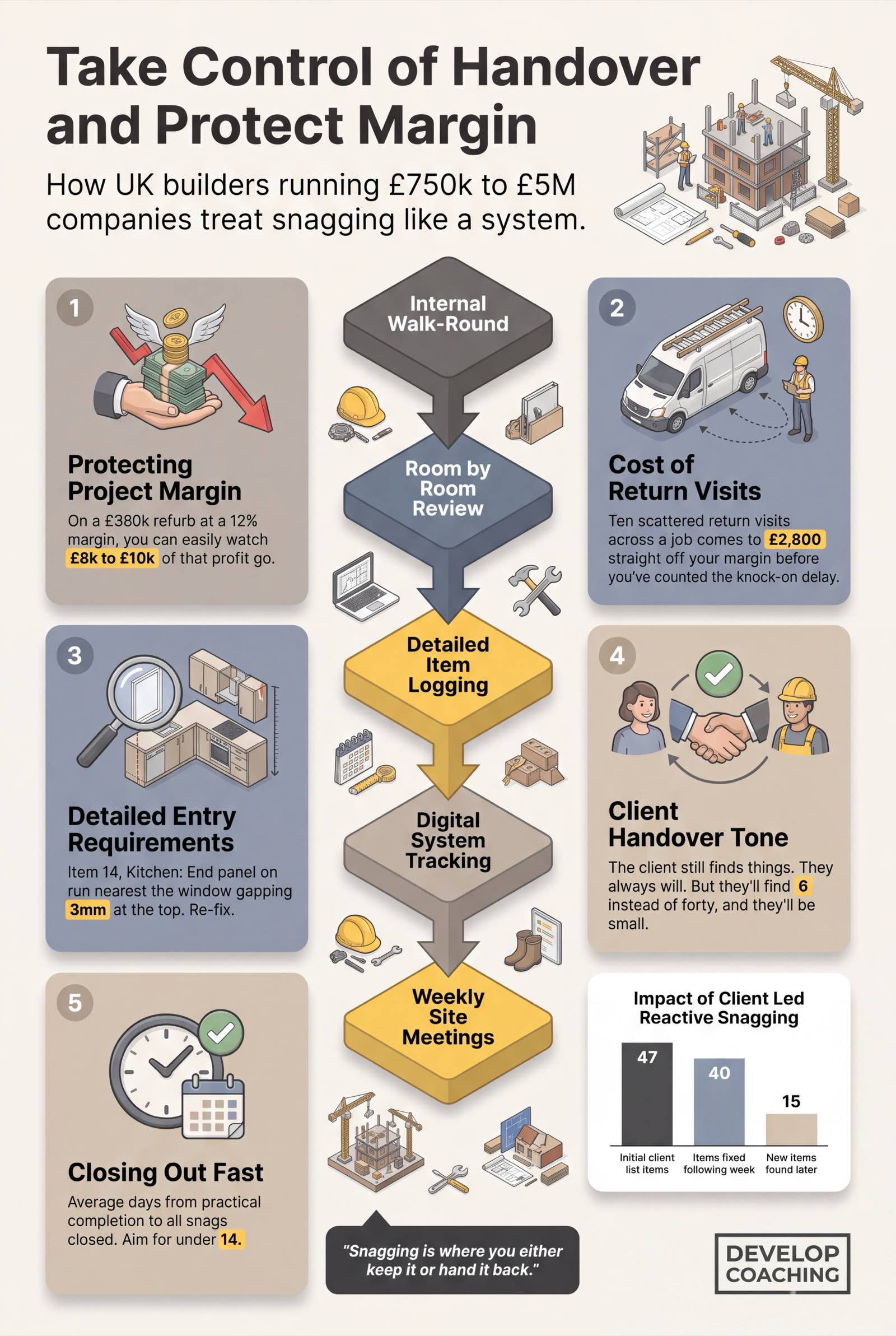
Start with a number. On a £380k refurb at a 12% margin, you've got roughly £45k of profit in the job. Now let snagging drift for six weeks. Send a carpenter and a decorator back four times each. Hold up the last £19k while the client "just checks a few more things". You can easily watch £8k to £10k of that profit go, and none of it shows on the programme. You only see it in the bank.
Most builders treat the snagging list as end-of-job paperwork. But when you're turning over £2M or £3M with six or eight jobs live, the way you handle snags decides whether you get paid on time, whether your best people stay on new work, and whether that client ever recommends you.
So treat it like a system. That means planning for it, running it yourself and closing it out fast.
What a snagging list is, and what it isn't
It's a written record of every defect, unfinished item or bit of poor workmanship that needs sorting before (or just after) handover. Think chipped skirting, a sticking door, missing silicone, a socket faceplate on the wonk, a scuff on fresh paint.
It isn't a wish list. And it isn't the client's tool for squeezing free extras out of you. That's where most of the trouble starts.
On a well-run job the list is short, specific and dated, and you're the one who wrote it. On a badly run job the client writes it, it never stops growing and nobody can tell you when the job's actually finished.
Why reactive snagging costs you so much
Here's how it usually goes. The client, or their surveyor or architect, walks the site with a notebook. You trail behind them. They write down 47 things. Your lads come back the following week and fix 40 of them, and by then the client has found another 15.
Round and round it goes.
Every return visit costs you a skilled tradesperson's day, the van, travel, and the job they were meant to be on. Call a carpenter £280 a day all-in. Ten scattered return visits across a job comes to £2,800 straight off your margin before you've counted the knock-on delay to the next site. Run that across 15 jobs a year and you're looking at £40k-plus. That's a full-time site manager's salary, gone on silicone and touch-ups.
It also hurts how people see you. A client who gets handed a half-finished house with tradespeople still in it doesn't remember the steelwork you got perfectly right. They remember the mess at the end. That's your construction brand taking a hit, and it's the story they'll tell their neighbours.
And there's cash. Final valuations and retention releases get held up while snags stay open. On a £600k job with 5% retention, that's £30k of your money sitting in someone else's account.
Run your own snag before the client ever sees it
This one change makes the biggest difference: don't let the client do the first walk-round. You do it, a week or so before they're due.
Your site manager or PM walks the whole job with a critical eye and logs everything. You fix it. Then you hand over a site that looks finished, because it is.
The client still finds things. They always will. But they'll find six instead of forty, and they'll be small. The whole tone of the handover changes. You stop defending yourself and start ticking off a short list together.
Walk it room by room, top to bottom
Give your team a set method so it doesn't depend on who's doing it. Ceiling, walls, joinery, floor, fixtures, services. Every room, the same order, every time. Open every door and window. Turn on every tap. Test every light and socket. Run the heating. It sounds basic, and it is. That's exactly why it gets skipped when everyone's tired and the next job is calling.
What a good entry looks like
Vague entries waste time. "Kitchen needs finishing" tells nobody anything. Here's a snagging list example of the level of detail you want on each line:
- Item 14, Kitchen: End panel on run nearest the window gapping 3mm at the top. Re-fix. Owner: Dave (joiner). Due: Thursday. Photo attached.
- Item 15, Kitchen: Silicone missing behind hob splashback. Owner: Mark. Due: Thursday.
- Item 22, Bedroom 2: Radiator valve weeping. Owner: heating sub. Due: Tuesday. Priority: high.
- Item 31, Hallway: Paint scuff by understairs cupboard, roughly 200mm. Decorator to touch in on final visit.
Every line gets a number, a location, a description, an owner, a date and, ideally, a photo. With those six things in place, nothing slips through.
Get it off paper and onto a system
A notebook in the site manager's back pocket is fine on one job. Across eight, it falls apart.
Use a snagging app or your project management software, whatever your team will actually use. You can attach photos, assign items, set dates and see what's still open on every job from your phone. When the client arrives for handover, you show them the list and say: "This is what we picked up on our own inspection, this is what's done, and these three are booked in for Wednesday."
Clients aren't used to that. Most builders they've dealt with wait to be told. Showing them the list first tells them you're organised and you're not hiding anything, and that buys you a lot of goodwill when something genuinely does go wrong.
You can also share the live list with the client so they can see items being closed with before-and-after photos. It cuts down the "any update?" calls massively. A client who can see progress doesn't feel the need to stand over your team.
The digital record helps if there's ever a dispute, too. If a client says six months later that you never fixed the bathroom door, you've got a dated photo showing it was signed off.
Build snags into your site meetings
Snags shouldn't only appear at the end. Pick them up the whole way through.
Your weekly meetings with PMs and site managers need a proper structure: minutes, actions, names, dates. Give snags their own section in every set of minutes, with a high, medium or low priority and a name against each one. An item stays on the minutes until it's closed. No exceptions.
Do this and you'll find most snags get fixed while the trade is still on site, which costs a fraction of a return visit.
Track client actions in the same meeting. Undecided tile choices, the bathroom suite still not ordered, the worktop template waiting on a decision. These hold up your programme more than anything your team does, and if you don't write them down with dates, you'll be blamed for the delay. Put a short programme update and a Gantt reference in the minutes as well so everyone knows where the job really stands.
Same goes for variations. If the client asks for an extra socket during a snagging walk, that's a variation and not a snag. Log it, price it, get it signed. Builders lose thousands a year by quietly absorbing "while you're here" jobs at the end.
This is what building construction business systems that run without you looks like day to day. Once your PMs and admin team can run snags, variations and client actions without you chasing, you're free to work on the business instead of getting dragged back to a job you thought finished in March.
What it does to your cash and margin
Let's put rough numbers on a business turning over £3M.
Say you complete 20 jobs a year. If tighter snagging takes three weeks off each close-out and saves four return visits per job, that's around 80 return visits gone. At £300 a time, call it £24k straight back into profit. Then add the cash you get earlier: final payments and retention released three weeks sooner on £3M of work makes a real difference to your overdraft, especially in a lean quarter.
That money pays for a better site manager, a new van or the cash buffer you need to take on a bigger contract. It's also why getting snagging under control matters as much as any pricing decision when you're chasing a healthy construction profit margin in the UK. You won the margin at tender. Snagging is where you either keep it or hand it back.
Your team notices the difference as well. Site managers who aren't constantly firefighting old jobs do better work on new ones, and they stay longer. Good people leave businesses that feel chaotic.
Turn good handovers into new work
In the Plan-Attract-Convert-Deliver-Scale framework, snagging sits in Deliver. But a clean handover feeds straight back into Attract.
Photograph finished jobs properly. Ask for a review the day you hand over the keys, while the client's happy. Write up the job as a short case study covering the brief, what you built, the timeframe and the fact it was handed over on time with a handful of snags closed inside a week. Put it wherever your best clients look. If you're not sure where that is, our guide to the best content marketing platforms for construction companies is a good place to start.
This is how you attract the right construction clients and not just more leads. People who care about quality and reliability pay for it, they're far less likely to nitpick, and they come back. A homeowner who gets a smooth handover on a £250k extension is the same person who calls you for the £600k new-build three years later.
Keep the pipeline full while jobs close out
Here's a pattern we see all the time. A builder gets so focused on finishing three jobs that nobody's chasing the next three. Then the gap arrives and the panic quoting starts.
The fix is to run your sales pipeline with the same discipline as your snags: every contact logged, every follow-up dated, nothing left to memory. Construction clients are rarely ready straight away. A homeowner might need six months to sort finance. An architect might be designing a scheme that won't go on site for a year. Without a system, those leads go cold and someone else gets the job.
Your contact list is one of the most valuable things your business owns. One good architect, developer or facilities manager can be worth millions over ten years of repeat work. So build it on purpose. Decide who your ideal referrers are (particular architects, surveyors, property managers in your area), use something like LinkedIn Sales Navigator to find them, and stay in touch regularly and usefully. That isn't spam. It's making sure that when they're ready, yours is the first name they think of. That's what steady construction lead generation looks like.
Keep the list clean so your emails actually land, and keep it GDPR-compliant. That applies to architects' details as much as homeowners'. Make sure your CRM and any list tools you use handle data properly.
The numbers to track as you scale
Taking a business from £1.5M to £4M doesn't mean doing the same thing harder. Things you could hold in your head at £800k simply don't fit there at £3M. Snags, pricing accuracy, material orders and labour scheduling all need to live in one central system that your team can see.
If cash feels tight as you grow, look at your close-outs before you look anywhere else. Very often the money's sitting in jobs that are 98% finished, held up by a dozen small snags and a final account nobody's chased. Scaling past £1M toward £5M puts a lot of strain on cash, and slow handovers make it far worse.
Track these every month as part of your construction business performance review:
- Average days from practical completion to all snags closed (aim for under 14)
- Number of return visits per job
- Cost of remedial work as a percentage of contract value
- Days from completion to final payment received
- Client satisfaction score at handover
If the numbers are drifting the wrong way, you'll know before it hits your margin. Usually the cause is training (site managers who haven't been shown what "finished" looks like) or the internal walk-round getting skipped when a job runs late. It's nearly always one of those two.
Get your construction job pricing right at the start and your snagging tight at the end, and the middle of the job gets a lot easier to run.
Where to go from here
A tight snagging list won't build a £5M business on its own. But it's a very good sign of whether the rest of your systems are working. Builders who run clean handovers usually have a grip on pricing, programmes and cash. Builders who don't are usually firefighting everywhere.
That's the work we do. Develop Coaching provides business coaching for UK builders running £750k to £5M companies who want the business to run properly without them holding every job together. We help you put the systems in place across all five stages (Plan, Attract, Convert, Deliver, Scale) so you can take on bigger work without losing quality, margin or your weekends.
If you're tired of jobs that never quite finish, book a free discovery call with us. We'll look at where your margin's leaking, from tender through to final payment, and give you a clear plan for what to fix first. Book your call today and get your business ready for its next big step.