


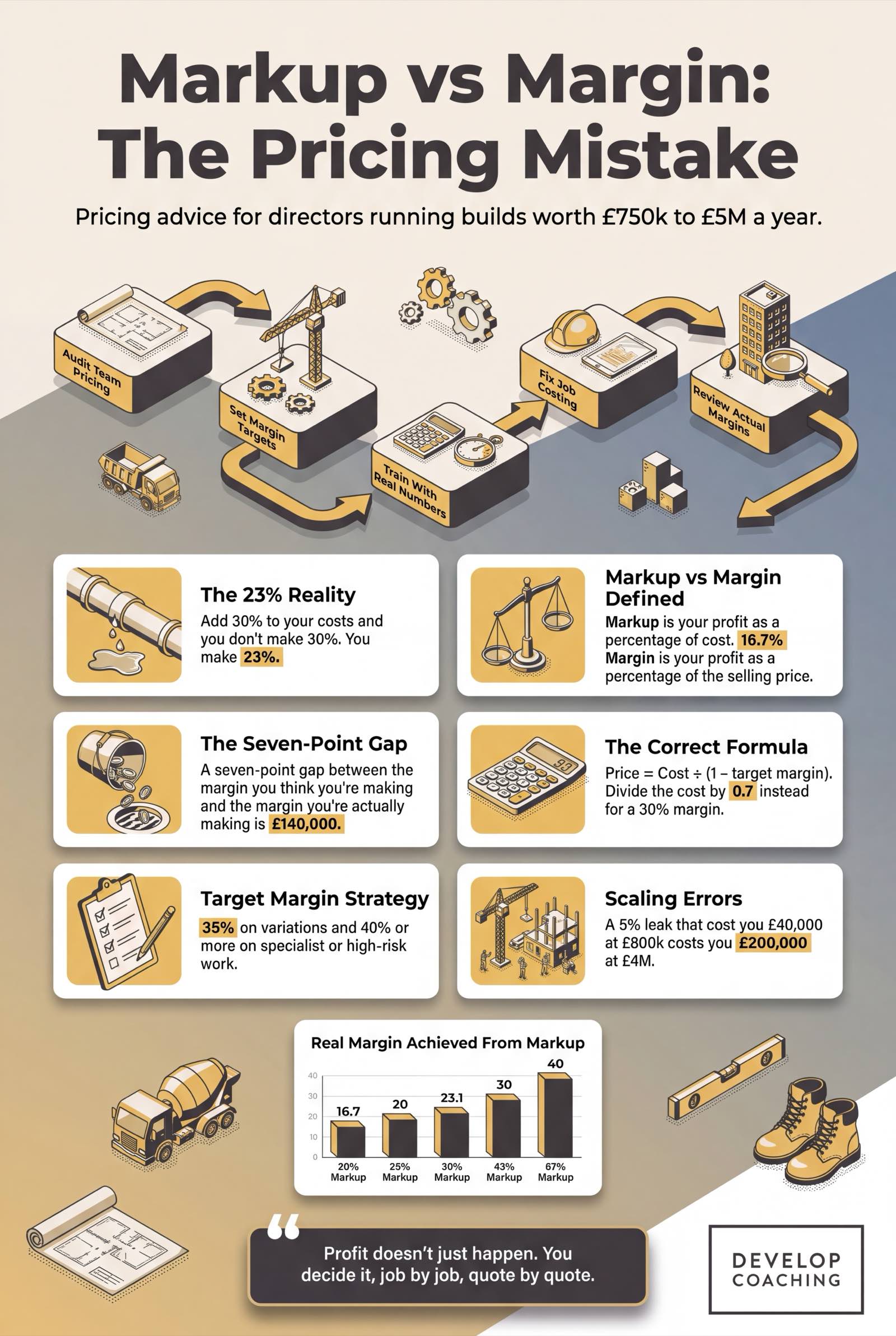
Add 30% to your costs and you don't make 30%. You make 23%.
Plenty of directors running builds worth £750k to £5M a year are pricing jobs on that mistake right now. They aren't careless, and most can run a site with their eyes shut. They've just never been made to sit down and work through markup vs margin properly, and their QS or project manager hasn't either. The result is a business that looks busy and turns over well, but still ends the year with less in the bank than it should have.
At your size, this isn't small change. On a £2M turnover, a seven-point gap between the margin you think you're making and the margin you're actually making is £140,000. Gone. And nobody can tell you where it went.
So let's fix it.
Markup and Margin Aren't the Same Number
Here's the simplest version I can give you.
Markup is your profit as a percentage of cost.
Margin is your profit as a percentage of the selling price.
Same pound notes of profit. Different thing you're dividing by. That's the whole difference, and it's enough to quietly drain a business.
Say a job costs you £100,000 to deliver. That's labour, materials, plant hire and your direct subbies. Charge the client £100,000 and you've made nothing. You've moved money around for a few months and taken on all the risk for the privilege.
Now you want £20,000 profit out of it. You add 20% to cost, so the price is £120,000. Easy.
But your margin isn't 20%. It's 16.7%. Your £20,000 of profit is sitting inside a £120,000 price, and £20,000 divided by £120,000 is 0.167.
That gap gets wider the higher you go:
- 20% markup = 16.7% margin
- 25% markup = 20% margin
- 30% markup = 23.1% margin
- 43% markup = 30% margin (near enough)
- 67% markup = 40% margin
Look at that last line. If you want 40% on specialist or high-risk work, you have to add two thirds on top of cost. Most builders would never think to put that much on. Which is exactly why they don't get 40%.
The £1M Job Where This Went Wrong
I'll tell you how I learned this one properly, because it cost us.
We were running a £1M project. Good client, decent spec, no drama on site. Over the life of the job it picked up about £300,000 of extras and variations, which is normal on a job that size when the client keeps changing their mind about the kitchen, the glazing and half the second fix.
The instruction to the project manager was clear: price every extra at a 30% gross margin.
He didn't. Not on purpose. He just took his cost for each variation and added 30% on top. In his head, that was 30%. To be fair, it's what most people would do.
As you've seen, a 30% markup gives you about 23%. On £300,000 of extras, that left us short by close to £30,000 against what we'd planned to make. That's a decent van, a site manager for part of a year or the deposit on your next bit of plant, all handed back to the client without anyone noticing.
And it took us a while to find it. The monthly figures showed margins slipping while turnover held up. We looked at the site first: waste, labour hours, the materials bills. All fine. The problem wasn't on site at all. It was a pricing habit nobody had ever trained out of him.
That's what makes this mistake so nasty. Nothing breaks. Nobody complains. The client's happy because the extras felt fair. You only see it months later in the management accounts, if you look closely enough.
Why Gross Margin Is the Number You Should Be Chasing
In the Plan-Attract-Convert-Deliver-Scale framework I use with builders, pricing sits right across Plan and Deliver. You plan the margin you need to fund the business. Then you deliver every job in a way that actually hits it. If those two don't line up, the rest of the framework doesn't matter much.
Gross profit margin tells you how much of every pound that comes in is left once you've paid for the job itself. That's the money that has to cover everything else: vans, insurance, the office, your estimator, your accounts person, software, marketing and your own wage. Whatever's left after all that is your net profit.
So if gross margin is thin, net profit has no chance. You can't cut your way to a healthy business from a 20% gross margin when you're carrying the overheads of a £3M operation.
I ask a lot of builders what margin they're making. The most common answer is "about 30%". When I push and ask whether that's gross or net, or margin or markup, the room usually goes quiet. That's not a dig. Most people were never taught it. But if you don't know which number you're on, you can't make a sensible call on hiring, on taking a big job, or on whether to drop your price for a client who's pushing back.
Working back from the margin you want
For most construction companies at your level, 30% gross margin is a sensible target. Some trades and some types of work will sit higher, and you should push for it. But let's use 30%.
Job costs £100,000. You want a 30% margin.
- Don't add 30% to £100,000. That gets you £130,000 and a 23% margin.
- Divide the cost by 0.7 instead (that's 1 minus your target margin). £100,000 ÷ 0.7 = £142,857.
- Your profit is now £42,857, which is 30% of the price.
- Your markup is roughly 43%.
The difference between £130,000 and £142,857 is nearly £13,000 on a single £100k job. Run 20 jobs like that a year and you're talking about a quarter of a million pounds.
The formula is worth sticking on the wall: Price = Cost ÷ (1 − target margin).
Getting the Whole Team Thinking in Margin
You might have this nailed yourself. That isn't the problem. Once you're past £1M, you're not pricing every job and every variation personally. Your QS is. Your project managers are. Sometimes a site manager is knocking out a price for an extra on the back of a docket because the client asked on a Tuesday morning.
Every one of those people needs to understand this without stopping to think about it.
The biggest killer of margin in construction is a job that's underpriced from day one. You can run the tightest site in the county and you still won't claw back a margin you never priced in. Good delivery protects margin. It doesn't create it.
Online tools like OmniCalculator are handy for checking a figure quickly. But I don't want a team that relies on a website to tell them what to charge. I want people who understand why 30% on cost isn't 30%, so they spot it when something looks off. The process should be the same every time: work out what it costs to deliver, then apply the markup that matches your target margin. A £2,000 variation gets the same treatment as a £400,000 contract.
Consistency is what gives you cash. And cash is what lets you hire a better site manager before you're desperate, buy plant rather than hiring it for the third year running, and ride out a wet winter or a quiet quarter without ringing the bank.
Putting Proper Pricing Systems in Place
Training on its own won't stick. People nod in a meeting, then go back to doing what they've always done the minute a client's chasing them for a price. You need a system, and you need to check it's being used.
1. Audit how your team prices right now
Sit down with your QS and each project manager. Ask them, one at a time, how they price an extra. Don't lead them. If any of them says "cost plus 30%" or "I just stick 25% on", get them to show you a few recent variations and work out the real margin together.
I'd put money on it being lower than you expected. Better to find out now than at year end.
2. Set clear margin targets by type of work
Not every job carries the same risk, so not every job should carry the same margin. You might go for 30% on standard extensions and refurbs, 35% on variations (they disrupt the programme and the client has no one to compare you against), and 40% or more on specialist or high-risk work.
Then give the team a one-page table that turns each margin into the markup they need to apply. Laminate it if you have to. Whatever stops the guessing.
3. Train with your own numbers
Generic examples don't land. Pull a real job from last year and show the team what the margin would've been if it had been priced properly. When a project manager sees that their habit cost the business £25,000 on one contract, they remember it.
And if any of your people are on a bonus tied to profit, show them the link. It's their money too. Funny how quickly the maths sinks in once that's clear.
4. Make sure your costs are actually right
All of this falls apart if your costs are wrong. Get the right margin on the wrong cost and you've still got the wrong price. If labour isn't being booked to jobs properly, or materials are going on one big account with no job codes, your margin figures are guesswork dressed up as numbers.
Get your job costing tight, then check actual margins against priced margins at the end of every job. If you want to dig further into how your numbers should be set up for growth, have a look at our guide on construction business performance.
Why This Gets More Important as You Grow
At £800k you might have four or five jobs on at once. At £4M you might have fifteen, with twice the subbies, a stack of variations moving every week and three or four people quoting on the company's behalf.
Small errors stop being small. A 5% leak that cost you £40,000 at £800k costs you £200,000 at £4M. Same mistake, same people, much bigger hole.
Get markup vs margin right across the whole team and you take control of your profit rather than finding out what it was after the year end. Your cash flow evens out. You can fund marketing, recruitment and new kit from profit instead of the overdraft. That's when growing towards £5M stops feeling like running faster to stand still.
There's another benefit people don't expect. When you know your numbers properly, you quote with confidence. You stop panicking and knocking 10% off because a client mentioned another builder. The clients you actually want, the ones who care about quality and a well-run job more than the cheapest price, pick up on that. It ties straight into attracting the right construction clients, because a builder who's sure of their price comes across as a professional outfit, not someone who's desperate for the work.
Profit doesn't just happen. You decide it, job by job, quote by quote. Pricing is one of the biggest levers you've got, and it costs you nothing to pull it properly. Your team just needs to know how.
Frequently Asked Questions
What's the main difference between markup and margin?
Markup is profit as a percentage of cost. Margin is profit as a percentage of the selling price. Put 20% on a £100 cost and you charge £120. That's a 20% markup, but only a 16.7% margin.
Why do project managers so often get pricing wrong?
Most of them came up through running sites, not through finance. Adding a flat percentage to cost is quick and feels logical, so that's what they do. Nobody's ever shown them that it leaves the business with a lower margin than it asked for.
How do I work out the markup I need to hit my target margin?
Work backwards. Divide your cost by 1 minus your target margin. For a 30% margin on a £100,000 cost, that's £100,000 ÷ 0.7 = £142,857. That works out as a markup of about 43%.
How much does getting markup vs margin wrong actually cost?
More than most people think. Aim for 30% margin but apply a 30% markup and you'll land at about 23%. On a business turning over £2M, a seven-point gap like that is around £140,000 a year in profit you've priced away.
How do I get my team pricing correctly?
Set clear margin targets for each type of work. Give the team a simple table showing the markup each target needs. Train them with real examples from your own jobs, and review their pricing regularly until it's second nature. Then keep checking.
Find Out What Your Pricing Is Really Costing You
If you've read this and thought "I'm not sure what margin we're actually making", you're not alone. You're also probably leaving serious money on the table every month.
At Develop Coaching we work with UK builders turning over £750k to £5M to get their pricing, margins and numbers sorted so the business can grow without the stress. Book a call with us and we'll look at a few of your recent jobs together, work out the margin you're really making against the one you think you're making, and show you exactly where the gap is. Most builders are surprised by what turns up. Then we'll show you how to close it.