

You run a construction company turning over somewhere between £750k and £5M. You've got the teams, the reputation, and you know how to build. But there's one type of project that will make or break your cash flow faster than any other: design and build.
Call yourself a design and build contractor and most people nod along like they know what that means. Plenty of builders who use the term on their vans couldn't tell you the difference between a JCT Standard contract and a JCT Design and Build contract if you asked them on the spot. There's a huge gap between winning this kind of work and actually delivering it without wrecking your margin or burning out your site team. If you're trying to move from £1M to £5M, you can't run every job the same way. You need a system that protects your profit and gives the client the one thing they're desperate for: certainty that it'll get done properly.
This guide covers the model itself, how to pick the right JCT contract, where early contractor involvement fits, and how to structure your site operations so you get paid on time without a daily fight.
What Does a Design and Build Contractor Actually Do?
Procurement is just the method a client uses to hire you. In the UK there are two routes you'll come across most: Traditional, and Design and Build.
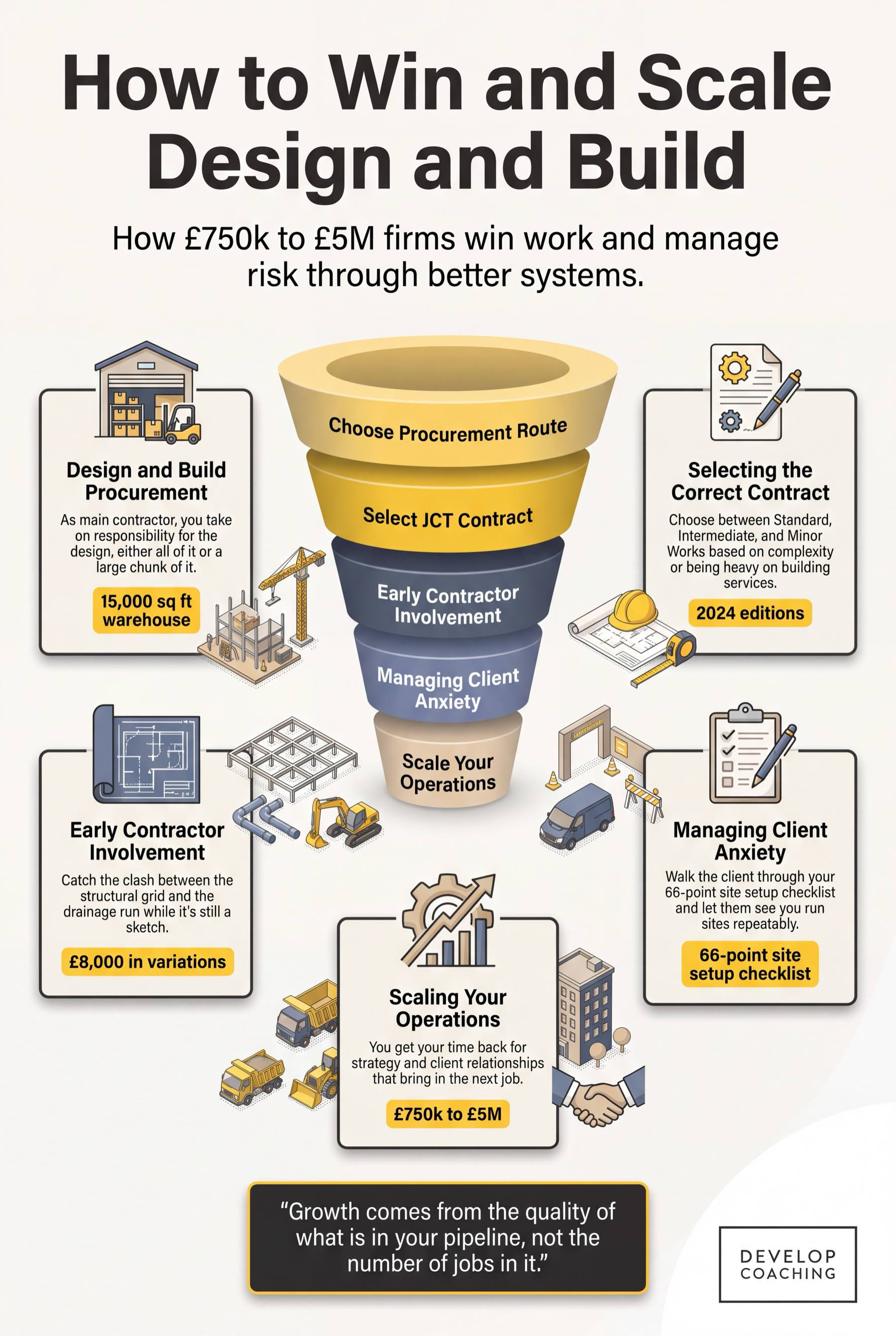
On a traditional job, an architect and a team of engineers finish 100% of the design before anyone even asks you for a price. You build what's on the drawing, full stop. Design and build flips that. As main contractor, you take on responsibility for the design, either all of it or a large chunk of it. The client's brief might be as loose as "build me a 15,000 sq ft warehouse with office space" and it's on you to turn that into both a workable design and a finished building.
You'll also run into a hybrid version called Contractor's Design Portion, or CDP. The project is mostly traditional, but you're handed design responsibility for one slice of it, maybe the M&E package, maybe the foundations. Don't treat CDP as lower stakes just because it's a smaller scope. You still own that piece completely, and if it goes wrong, it's your name on it.
This procurement route gets used so much on bigger jobs because it's genuinely faster. You can start designing elements before the whole scheme is finalised, which means spades in the ground sooner. The catch is that all the coordination risk lands on you. Miss the clash between the structural steel and the ductwork and that's not the architect's problem anymore. It's yours, and it comes straight out of your margin in rework.
Choosing the Right JCT Contract
Here's the mistake that costs builders the most money: signing the wrong contract because someone handed them a template and said "this is what we always use." The JCT (Joint Contracts Tribunal) sets the standard forms used across the UK. The 2024 editions are rolling out now, but the underlying logic hasn't changed much from the 2016 versions most of the industry still uses.
If you've taken on design responsibility for the whole scheme, there's really only one option: the JCT Design and Build Contract. It's a dense document, but it's built for exactly this situation, where you're carrying the design liability as well as the construction risk. Don't try to bolt design responsibility onto a traditional contract. The protections you need simply aren't in there.
Most of your work, though, will sit somewhere else: traditional procurement with a CDP, or standard works with no design input at all. For those, you're choosing between Standard, Intermediate, and Minor Works. A rough way to decide:
- Complex, or heavy on building services? Basements, lifts, BMS systems, anything with real technical risk. Use the JCT Standard Building Contract without quantities. Think twice before signing a Standard contract with quantities unless you've had it checked by a construction solicitor first. The way variations and final accounts work under "with quantities" catches out more builders than you'd think.
- Detailed but not overly complex? Named subcontractors, defined procedures, several trades on site at once. This is the JCT Intermediate Building Contract, and it's the right fit for a large share of your £1M to £2M jobs.
- Simple and narrow? A single trade package, or a small job with nothing complicated running through it. Minor Works does the job here. For a full build from foundations to roof, Intermediate gives you far more protection and it's worth the extra paperwork.
Steer well clear of the Homeowners contract for anything commercial or any serious residential job. It's built for a different scale of risk entirely. Prime Cost (cost plus) contracts have their place, but that place is an emergency where speed matters more than price certainty, not your day-to-day pipeline. For normal operations, stick to fixed price or measured terms under Standard or Intermediate.
Early Contractor Involvement: Where the Real Money Sits
You'll see vans and websites advertising design and build services all over the place. What most of them are missing is that the real margin sits earlier in the process, in what's called Early Contractor Involvement, or ECI.
Instead of waiting for a finished drawing set to tender against, you're in the room while the design is still being shaped. Why does that matter so much? Because you can push back on buildability and cost before the architect has locked in something expensive or awkward to construct. You catch the clash between the structural grid and the drainage run while it's still a sketch, not a problem on site costing you £8,000 in variations three months in.
Getting brought in early is about more than winning the job, though that's part of it. It's about setting up the whole delivery phase to go smoothly. One thing to watch: when you're involved this early, you're often paid as a consultant first rather than as the main contractor. Make sure your fee structure reflects that. Don't let a client use you for your design input on a fee basis with no clear route through to actually securing the construction contract afterwards. Use that early access to build trust and shape your proposal around the client's real worries, which is exactly what we cover in our guide on attracting the right clients.
Get this right and you stop being a bidder competing on price and become the advisor the client trusts with the whole project. That's where higher margins come from, not from cutting your rate to win the tender. It also lets you lock in prices on long-lead items, kitchens, structural steel, specialist glazing, while the design is still being finalised, which protects you against the kind of price inflation that's eaten plenty of margins over the last few years.
Managing Client Anxiety: The Deliver Phase
Winning the job is the easy half. What comes next is managing the client, and for most clients this is the biggest, most expensive thing they've ever commissioned. They're worried about the budget running away from them, the programme slipping, and the finish not matching what they pictured. Part of your job, whether you like it or not, is managing that anxiety with systems rather than reassurance alone.
Start the onboarding the day the contract is signed, not on the day the groundworks start. Use that gap to map out every stage from sign-off to handover. Walk the client through your 66-point site setup checklist and let them see, in black and white, that you run sites the same repeatable way every time. There's a full breakdown of how to build that in our construction site set up guide.
Communicate before they have to ask. If a client's worried about costs creeping, show them your quality control documents. Walk them through the checklists you use at roof sign-off, or when M&E gets tested. It tells them, without you saying a word, that someone is watching every stage. If the worry is the programme slipping, pull up the critical path and explain how materials get ordered weeks or months ahead specifically to avoid the delays they're imagining.
This is also where repeat business comes from. You're not just handing over a building, you're managing how the whole process felt for them. Get that right and it lines up with what we talk about in running projects that pay: clients who feel safe stop micromanaging you, and that frees up hours of your week you didn't know you were losing.
Attracting the Right Work: The Plan Phase
You won't get to £5M chasing low-margin jobs that keep you up at night. You need a marketing engine that pulls in clients who actually value what you do, not just the cheapest quote on the table. That starts with knowing exactly what makes you different, and saying it plainly.
What do your best-fit clients actually worry about before they've met you? Missed deadlines? Being left in the dark for weeks at a time? Ask your current clients what frustrated them about builders they've used before. If the answer is "they never turned up when they said they would," your proposal needs to lead with how your site supervision actually works, not a generic line about quality.
Your marketing shouldn't just chase volume. It should filter for the right kind of client, which is the whole point of mastering construction business marketing. Use email and social media to build a relationship with the architects and developers who specify work like yours, and show them you understand design coordination, not just the trade itself.
Scaling Your Operations: The Scale Phase
Getting past £1M and towards £5M means getting yourself out of the daily fire-fighting. That doesn't happen by accident. It takes proper construction business systems that keep running whether you're on site or not.
Look hard at what you're doing yourself that someone else could do better. Marketing, branding, even sourcing decent subcontractors, specialist agencies like Construct Virtual exist precisely for this. Hand it over and you get your time back for the two things that actually move the business forward: strategy and the client relationships that bring in the next job.
And track the numbers that actually tell you something. Gross profit margin per project. Cash flow forecasting accuracy. These two alone will tell you more about the health of your business than turnover ever will, and you can dig into exactly what to track in our piece on construction business performance. If a job comes in with thin margins or a scope that's still vague three meetings in, walk away from it. Growth comes from the quality of what's in your pipeline, not the number of jobs in it.
Own the Process
Being a good design and build contractor isn't about being the cheapest name on the tender list. It's about offering certainty in an industry that runs on uncertainty: the right contract to limit your liability, early involvement to shape the solution before it's locked in, and client management that's built on systems rather than hope.
Get those three things right and something shifts. You stop chasing work and start being chosen for it. That's a different business entirely, one that's profitable, scalable, and doesn't fall apart the moment you take a week off.
So have an honest look at where you stand right now. Are you on the right contract for every live job, or just the one everyone defaults to? Do you actually have a repeatable checklist running on every site? Is your marketing filtering out the wrong clients, or just filling the pipeline with whoever enquires?
If you want help turning that into a proper system rather than a list of good intentions, book a 10-minute chat with our team. We'll talk through where your business sits today and what it would take to get you consistently winning higher-margin work.