


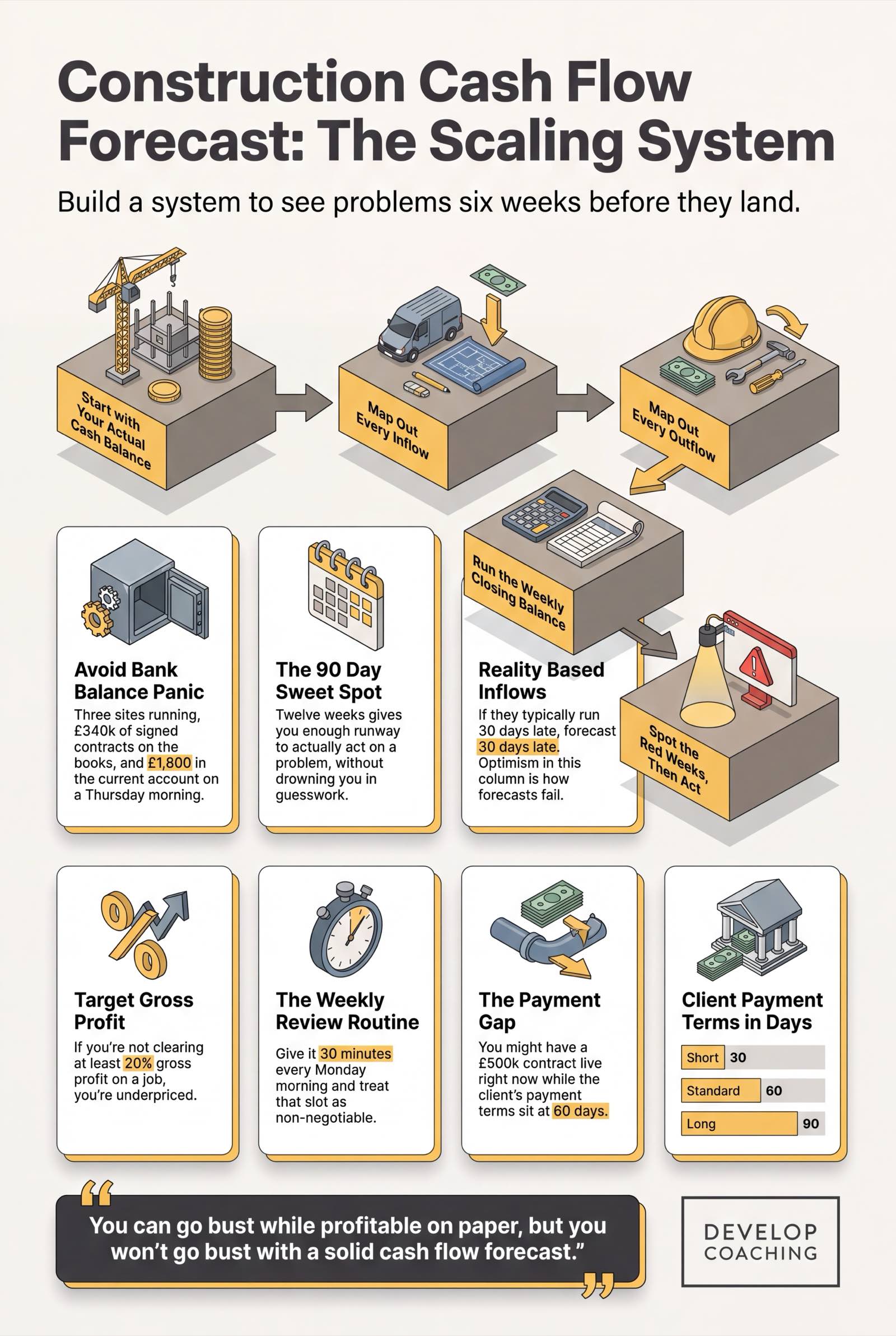
Picture this: three sites running, £340k of signed contracts on the books, and £1,800 in the current account on a Thursday morning because your biggest client pays on day 58 of a 60-day term. That's not a struggling business. That's a business with no construction cash flow forecast. And it's more common at £1M to £3M turnover than most owners admit, because the business has outgrown the "just check the bank balance" method but hasn't yet put a proper system in its place.
More revenue does not mean more cash. Say that to yourself before you read another word, because it's the single biggest myth that trips up builders trying to scale past £1M. Suppliers want paying now. Clients hold your money for 30, 60, sometimes 90 days. Projects slip. Put those three things together and you can be sitting on contracts worth hundreds of thousands and still not have enough to cover Friday's wages.
The fix isn't to work harder or chase more jobs. It's to build a construction cash flow forecast and actually use it, every week, without fail. Done properly, it turns you from someone firefighting bank balance panic into someone who sees a problem six weeks before it lands and deals with it calmly.
Why Revenue Growth Masks Cash Flow Problems
At £800k turnover, you probably know your financial position because you glance at the bank app most mornings. That works, up to a point. Push past £1.5M, run three or four sites at once, and that habit falls apart. There are simply too many moving transactions for a gut-feel check to catch what's coming.
Here's the real problem underneath all of it: the gap between doing the work and getting paid for it. You might have a £500k contract live on site right now, labour and materials going out every single week, while the client's payment terms sit at 60 days. For two months you are, in effect, bankrolling that client's project out of your own working capital. You won't see that deficit on a spreadsheet of profit. You'll see it when the account hits zero and you're on the phone to the bank asking about an overdraft extension.
A forecast catches that gap before it becomes a crisis. It answers one blunt question: have I actually got enough money to finish this job? If the answer's no, you've still got time to move. Renegotiate terms, chase the supplier for more breathing room, arrange finance. Do that in week three of a problem, not week eleven when the wages run are already late. This is how you avoid the classic trap: a healthy-looking P&L and an empty bank account. Plenty of builders go bust while technically profitable. Don't be one of them.
The 90-Day Forecast: The Sweet Spot for Builders
Owners tend to get the timeframe wrong in one of two directions. Some only look two or three weeks ahead, which means every surprise lands on top of them with no warning. Others try to build a full annual forecast, which sounds thorough but is out of date within a fortnight on a live site. Neither works.
Ninety days is the right window. Roughly a quarter, which conveniently lines up with your VAT cycle, so you can see the dip that always hits when that bill falls due instead of being ambushed by it again. Twelve weeks gives you enough runway to actually act on a problem, without drowning you in guesswork about month nine.
One thing that trips people up: don't do this monthly. A monthly view smooths out the exact weeks where you're exposed, and those are usually the weeks that breach the overdraft. You need a week-by-week breakdown across the full 90 days. It's a bit more admin to set up once, but it's the difference between spotting a problem in week 4 and discovering it the hard way in week 4.
How to Build Your Construction Cash Flow Forecast
You don't need expensive software for this. A spreadsheet works fine, and a tool like Xero can do the heavy lifting on the data side while you build the habit. What matters more than the tool is the sequence: opening balance, inflows, outflows, then the gap.
1. Start with Your Actual Cash Balance
Open the document and type in today's real bank balance. Not a rough guess, not last week's figure. If you've got a VAT account or a separate payroll account sitting alongside your main one, add those in too. You want the true net position, not the number that happens to be sitting in the account you check most often.
2. Map Out Every Inflow
List everything due to land over the next 12 weeks:
- Progress payments tied to milestones on live projects.
- Invoices already sent that are sitting in your debtor book.
- Deposits for signed work that hasn't started yet.
Be honest about timing here. If a client's never once paid on the day the invoice lands, don't put them down for that. Look at your own history: if they typically run 30 days late, forecast 30 days late. Optimism in this column is how forecasts fail.
3. Map Out Every Outflow
Group this into roughly ten categories so it stays usable. You're not tracking every box of screws here, that's what the P&L is for. This is about liquidity, not profit. Cover:
- Materials tied directly to live projects.
- Labour, including PAYE and NICs.
- Subcontractor payments.
- Plant hire and equipment rental.
- Rent and utilities on your office or yard.
- Insurance.
- VAT and Corporation Tax provisions.
- Loan repayments and interest.
- Your own drawings or salary.
For materials, a rough percentage based on your historical average is fine for weeks ten and eleven. For the next two or three weeks, use actual supplier payment runs. That's where accuracy actually matters.
4. Run the Weekly Closing Balance
The maths here isn't complicated. Opening balance, plus inflows, minus outflows, equals closing balance. Then the closing balance for week one becomes the opening balance for week two, and so on across all twelve weeks. Once it's set up, dragging that formula across the sheet gives you a visual line of where your cash is heading, up or down, week by week.
5. Spot the Red Weeks, Then Act
Scan down the row of closing balances. Any week that goes negative, or gets uncomfortably close, is a week you now have advance warning on. That's the entire point of the exercise. Options once you spot one:
- Invoice the moment you hit a milestone. Don't let paperwork sit on a desk for a week.
- Push back on terms. Ask the supplier for a few extra days, or offer the client a small discount for paying early.
- Move the spend. Plant hire or non-urgent purchases can often shift two or three weeks without anyone noticing.
- Sort finance while you're still healthy. An overdraft or invoice finance facility is easy to get when you don't desperately need it. Much harder once you do.
The Weekly Review Routine
A forecast built in January and never touched again is worthless by March. This only works as a living document, so give it 30 minutes every Monday morning and treat that slot as non-negotiable.
Four steps, every week:
- Pull the actual bank transactions from the previous week.
- Check your opening balance matches the real statement, not what you expected it to be.
- Update anything that's changed: a client's confirmed payment for next Tuesday, a supplier invoice that came in £2k higher than quoted.
- Roll the whole forecast forward one week.
Do this consistently and the guesswork disappears. You stop wondering where your money's going and start knowing, to the week, where your lowest point sits over the next three months. That's what lets you say yes to a big materials order or a new hire without that nagging worry you'll regret it in six weeks.
Avoiding Common Scaling Traps
Two things wreck cash flow more than anything else as builders push towards £5M, and both are fixable once you see them clearly through the forecast.
Underpricing Jobs
If you're not clearing at least 20% gross profit on a job, you're underpriced. For a business aiming to scale sustainably, 30% is a better target to work towards. Thin margins leave you nothing to absorb a bad week of weather, a price hike on steel, or a client who pays ten days late. Get your pricing right and every job adds to your buffer instead of eating into it. We go into this properly in Construction Job Pricing: Price Every Job for Real Profit.
Poor Invoicing and Payment Terms
Don't agree to 60-day terms if you've got any room to negotiate. If you're stuck with them, chase every invoice like it's overdue the moment it's late, because it is. Every invoice should state the payment date clearly, no ambiguity, no "within 30 days of receipt" vagueness that gives a client an excuse. If you're running several sites at once, get software in place that gives you a real-time net cash position rather than a monthly snapshot. The basics are covered in Accounting for Construction Companies: The Basics.
Integrating Cash Flow into Your Growth Strategy
None of this is just defensive. Once you actually know your cash position, you can bid on bigger projects that need serious upfront capital, because you know you can fund the gap. You can take on another team, invest in better kit, and know you'll cover payroll through the lean weeks that follow.
It also changes how you choose clients. When you're working through Attract the Right Construction Clients, Not Just More Leads, a solid cash position means you can afford to walk away from a slow payer instead of taking any job that's offered because you're nervous about the bank balance. The same goes for tracking Construction Business Performance: The Numbers to Track, where your cash figures and your operational targets should be telling the same story, not fighting each other.
There's a personal side too. Plenty of builders put every spare pound back into working capital and never actually take anything out for themselves, year after year. Get your cash flow under control and you create room to change that. Worth reading alongside this: How to Become Financially Free as a Business Owner.
Protect Your Pulse
Think of cash flow as the pulse, not the weight. A business can look heavy and healthy on paper and still flatline if the pulse stops. Profit matters for the long game. Cash is what keeps the lights on this month. You can go bust while profitable on paper, but you won't go bust with a solid construction cash flow forecast sat in front of you every Monday morning.
Don't leave this to chance. Build the 90-day version this week: today's balance, every inflow and outflow mapped week by week for the next twelve, reviewed every Monday without exception. It's a couple of hours to set up and half an hour a week to maintain. That's a small price for never again finding out about a shortfall the day it hits your account.
If you want a second pair of eyes on your numbers, or you're not sure where the gaps are in your own forecast, that's exactly the kind of thing we work through with builders scaling from £750k towards £5M. Book a call with Develop Coaching and we'll look at your actual numbers together, not generic advice, your business, and build a plan to get your cash flow solid enough to support the growth you're chasing.