If you've typed "construction social media" into Google, you're probably past the stage of wondering whether you should bother. You already know your competitors are posting site photos and before-and-afters. What you actually want to know is which platforms are worth your time, what to post on them, and how any of it turns into enquiries rather than just likes. That's what this guide covers, with no fluff and no vanity metrics.
For a UK building or construction company turning over £750k to £5M, social media isn't a side project you hand to whoever's youngest in the office. Done properly, it's a lead generation channel, a recruitment tool, and a way to build a brand that lets you charge a fair price without being the cheapest quote in the pile. Done badly, it's an hour a week wasted on posts nobody sees. The difference is strategy, not talent.
Why construction social media matters more than you think
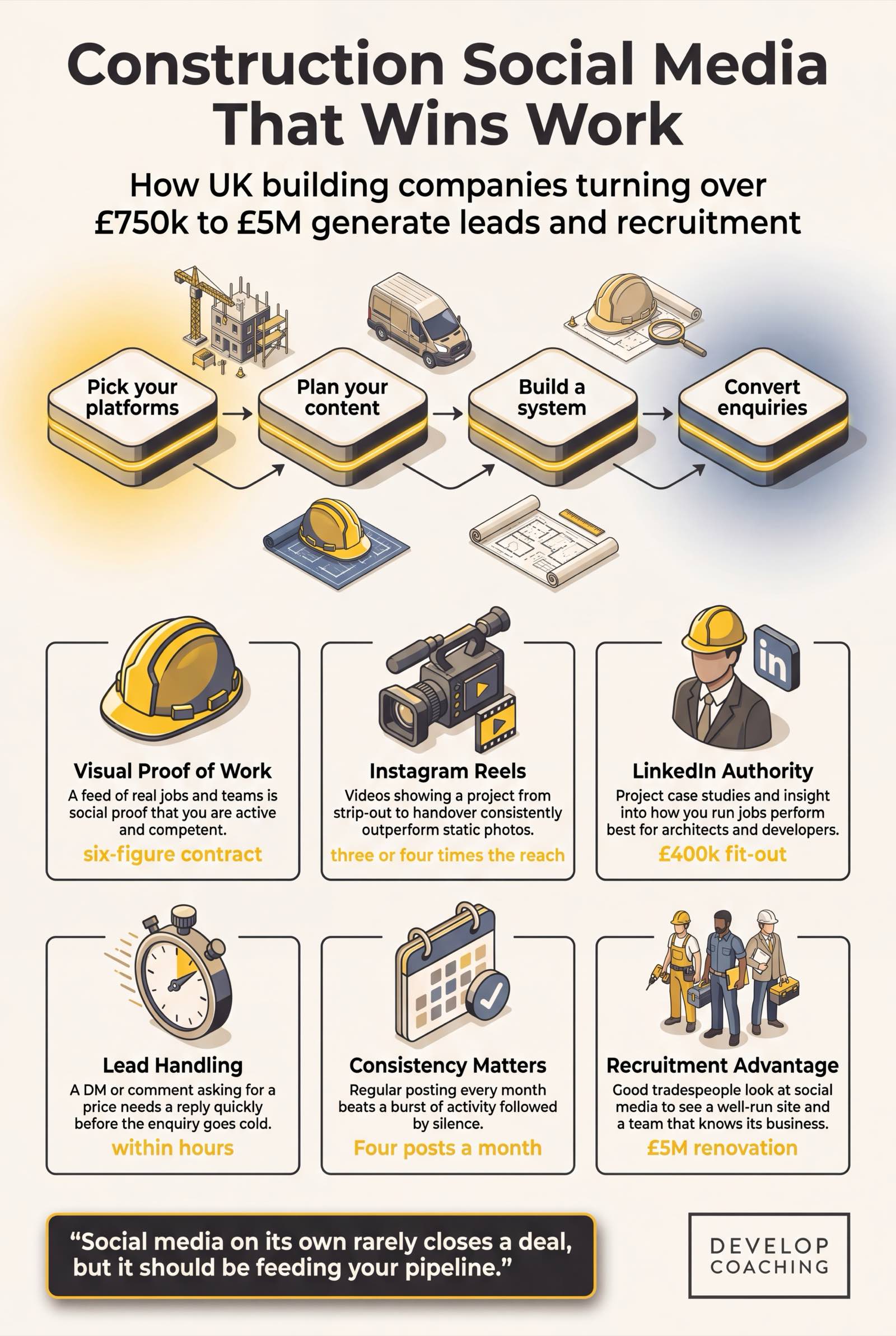
Commercial clients, architects, and homeowners with big renovation budgets all do the same thing before they call you: they check you out online. Your website tells them what you say about yourself. Your social media tells them what's actually true, because it's harder to fake a feed full of real jobs, real teams, and real clients than it is to fake a website. A strong, consistent presence is social proof that you're active, competent, and still trading, which matters more than people admit when they're about to hand over a six-figure contract.
It also does double duty on recruitment. Good site managers and tradespeople look at a company's social media the same way they'd look at Glassdoor. If your feed shows a well-run site, decent kit, and a team that looks like it knows what it's doing, you'll find hiring easier. If there's nothing there, or it's three years out of date, that's a red flag to anyone vetting you before an interview.
Which platforms are worth your time
You don't need to be everywhere. Pick two, maybe three platforms and run them properly rather than spreading yourself across five and doing all of them badly.
Still the best platform for visual proof of work. Reels showing a project from strip-out to handover consistently outperform static photos, often by three or four times the reach. Stories are useful for day-to-day site updates and team shoutouts that don't need to be polished. If your business does anything that looks good on camera (groundworks, extensions, fit-outs, timelapse builds), Instagram should be in your top two.
Underrated for construction, particularly if a chunk of your work comes from local homeowners or small commercial clients rather than pure B2B tendering. Facebook's audience skews older than Instagram's, which often maps onto the people actually signing off budgets. It's also where local community groups live, and a recommendation in a village or town Facebook group is worth more than most paid ads.
This is where you win work from architects, developers, and commercial clients. If you're bidding on contracts or chasing repeat work from developers, LinkedIn is where decision-makers actually spend time during the working day. Posts here should look different to Instagram: fewer site selfies, more project case studies, numbers, and insight into how you run jobs. A post about how you kept a £400k fit-out on schedule despite a supply chain delay does far more work on LinkedIn than a nice drone shot.
YouTube and TikTok
Worth considering if you've already got Instagram working and have the appetite to go longer-form. YouTube is where "how we built X" content lives well, and it compounds over years in search in a way Instagram posts don't. TikTok reaches a younger audience and is useful for recruitment more than lead generation, since most people hiring a builder for a £5M renovation aren't scrolling TikTok to find one.
What to actually post
The biggest reason construction social media fails is that companies post whatever's easiest that week instead of planning content around what their audience actually wants to see. Here's what tends to work:
- Before, during, and after sequences. The single best-performing content type across the trade. Show the mess, show the mid-point, show the finish. It proves capability better than any sales line.
- Behind-the-scenes process content. How you price a job, how you run a site briefing, how snagging works. This builds trust with clients who've been burned by cowboy builders before and want to see a proper process.
- Team and culture content. Introduce your site managers, your apprentices, your longest-serving tradespeople. This does more for recruitment and client trust than any logo or stock photo ever will.
- Client testimonials on camera. A 30-second clip of a client saying you turned up on time and stuck to budget beats a five-star review nobody reads.
- Numbers and insight. Posts that teach something (how to budget for an extension, what drives up groundworks costs, how retention works on a contract) position you as the expert rather than just another contractor.
Whatever you post, keep your branding consistent: same logo placement, same colours, same tone. If you haven't nailed down what your construction brand actually stands for, social media will expose that inconsistency fast, because every post is a chance for your brand to look either sharp or scrappy.
Turning posts into enquiries
This is where most companies fall down. They post consistently, build a decent following, and still can't link any of it to actual work booked in. Social media on its own rarely closes a deal, but it should be feeding your pipeline, not sitting separate from it.
A few things make the difference:
- Every post needs a next step. A link in bio, a clear "message us for a quote," or a comment prompt. Don't assume people will go looking for your contact details.
- Respond fast. A DM or comment asking "how much for something like this?" needs a reply within hours, not days. Slow replies are the main reason social enquiries go cold before they ever reach your sales process.
- Feed it into your wider construction lead generation system, rather than treating it as a standalone activity. Social proof warms people up; your actual enquiry handling and quoting process is what converts them.
- Use reviews as content. If you're not actively gathering reviews, you're leaving your strongest conversion tool unused. Pair that with a proper approach to getting customer reviews for your construction company, and you've got a constant supply of proof to repost.
Running it without it eating your week
At £750k to £5M turnover, you don't have time to be your own social media manager, and you shouldn't be. The owners who get the most out of construction social media are the ones who've built it into a system rather than a task that depends on them remembering to do it.
Practical ways to make that happen:
- Batch filming on site visits. Fifteen minutes of footage once a week, captured by whoever's already there, gives you a month of content with proper editing.
- Brief your site managers to send photos and short clips as a habit, the same way they'd send a daily report. Make it part of the job, not an optional extra.
- Use a scheduling tool so posting doesn't depend on someone remembering to do it live. Plan a month at a time and let it run.
- Hand editing and posting to a junior team member, an admin hire, or an external marketing contractor once you've got a content pipeline. Your time is better spent on the jobs that actually move turnover, not trimming video clips.
This is the same principle behind building any part of the business that shouldn't depend on you personally. If social media only happens when you remember to post it, it's not a system yet, it's a habit, and habits break the moment you're busy. The same thinking that goes into building construction business systems that run without you applies directly here: define who does what, on what schedule, and check the output monthly rather than doing it all yourself.
Common mistakes to avoid
- Posting only finished work. Clients want to see the process, not just the result. A feed of only glossy after-shots looks staged.
- Going quiet for months, then posting a burst. Consistency matters more than volume. Four posts a month, every month, beats twenty posts in one week followed by silence.
- Ignoring comments and messages. A neglected inbox tells potential clients you're hard to reach before they've even spoken to you.
- Treating social media as separate from the rest of your marketing. It should sit inside your wider plan, not run as its own disconnected activity. If that wider plan doesn't exist yet, that's worth fixing first; see our guide to mastering construction business marketing for how the pieces fit together.
Where to start
If you're starting from close to nothing, don't try to do everything at once. Pick one platform (Instagram or LinkedIn, depending on whether most of your work is private clients or commercial), post consistently for eight weeks, and track what actually gets enquiries rather than what gets likes. Expand from there once you've got a rhythm that doesn't depend on you personally doing the filming, editing, and posting every week.
Construction social media works when it's treated like any other part of running the business: planned, delegated, and measured against results rather than effort. Get that right and it becomes one of the cheapest, most reliable ways to win work and attract the right people to your team.
If you want help building a marketing system that actually ties your social media, lead generation, and sales process together instead of running them as separate, disconnected jobs, get in touch with Develop Coaching for a free consultation. We'll look at what you're doing now and show you exactly where the gaps are costing you enquiries.