
You’ve hit £1M turnover. Good. But if the business still feels like it’s running you rather than the other way around, your current approach has a ceiling. Most builders who reach that mark got there on word-of-mouth and a scattergun approach to tendering. That works up to a point. It won’t get you to £3M, let alone £5M. To break through, you need a construction company marketing strategy that generates demand on your terms, not one that just reacts to whatever lands in your inbox.
Scaling past that threshold isn’t about grafting harder. It’s a genuine shift in how you think about the business. You’re no longer just a builder. You’re a business owner who happens to build things. That means moving away from the feast-or-famine cycle and putting a system in place that attracts the right clients, converts them without slashing your margin, and delivers results that justify a premium price. What follows is the framework we use with our clients to do exactly that.
Phase 1: Plan and Position Your Brand for Competitive Advantage
Before you spend a penny on ads or start posting on LinkedIn, get clear on who you are and who you serve. It sounds obvious. Most builders skip it entirely. And it costs them.
The mistake most growing construction businesses make is trying to appeal to everyone. You can’t be the cheapest, the quickest, and the most premium outfit on the street. Pick your lane. If you’re targeting high-end residential clients spending £200k or more on extensions and full refurbishments, your brand needs to reflect that. If your bread and butter is commercial fit-outs for mid-size businesses, position for that market specifically. Trying to do both badly wins you neither.
Understanding Your Competitive Landscape
To win work consistently, you need to understand the gap between you and your competitors. Not to rubbish them, but to find what you genuinely do better. As we discussed in our podcast with John Lenker, branding isn’t your logo or your van livery. It’s the way you operate, the voice you use, and the promise you keep, every time, on every job.
When you carry out a competitor analysis, look for the gaps. Are your rivals slow to respond to enquiries? Do they go quiet mid-project? Do clients complain about surprise costs on handover? If you’re known for meticulous site management, clear weekly client updates, and no-surprise pricing, that’s your brand. Make it explicit in everything you do.
Defining Your Brand Voice
Your brand voice should feel like a conversation with someone you’d trust to build your own house. Clients don’t hire logos. They hire people they believe in. Your marketing plan must reflect the progression of that trust, from first impression through to signed contract. Whether you’re targeting private homeowners in the Home Counties or commercial developers in Manchester, your messaging must feel authentic and consistent. It should signal that you’re the builder worth paying a bit more for.
Phase 2: Attract the Right Leads with a Hybrid Strategy
Once your positioning is locked in, the right marketing strategy for a construction company at your scale isn’t simply about being visible. It’s about keeping your pipeline full of qualified work, not just any work. Sitting back and waiting for the phone to ring is a strategy for standing still. You need both outbound precision and inbound authority working together.
The LinkedIn Strategy for B2B Construction
If you’re targeting commercial clients, architects, or developers, LinkedIn is your best tool right now. Most builders use it wrong, firing off connection requests with generic pitches. That’s the digital equivalent of cold calling and it gets the same result: ignored.
The approach that actually works has three stages:
- Sort Your Profile First: Your LinkedIn profile isn’t a CV. It’s a landing page for your professional reputation. It should be clear about who you help, what you build, and why clients choose you. A photo of you on site, in your PPE, beats a corporate headshot every time.
- Find and Engage Before You Pitch: Identify the architects, project managers, and procurement officers in your target market. Before you reach out, spend a couple of weeks commenting meaningfully on their posts. Not just “great post!” but something that shows you’ve read it and have a genuine view. Your name starts appearing in their feed. You build familiarity before you’ve ever sent a message.
- The Pattern Interrupt: Once you’ve connected, don’t open with “are you looking for a contractor?” That’s noise. Try something unexpected: a genuine question about a challenge they’ve mentioned, a short piece of useful insight, or even a physical gesture like a handwritten note or a small branded gift to their office. One client of ours sent cupcakes in their company colours to three architecture firms they’d been engaging with online. They got meetings with two of them within a fortnight. The goal is a conversation, not an immediate job. But that conversation is how you get onto tender lists.
Inbound Marketing and Your Digital Presence
For private clients, your digital presence does the qualifying for you. A coherent digital marketing strategy isn’t just about having a website. It’s about having content that addresses the things your ideal clients actually worry about: budget overruns, unreliable trades, projects that drag on, sites left in a mess at the weekend. Speak to those fears directly.
Your website should feature detailed case studies, not just a gallery of glossy finished photos. Show the process. A before-and-after of a tricky structural challenge tells a proper story. It shows competence. It demonstrates that when something goes wrong (and something always does), you’ve got the knowledge and the team to handle it. That’s what wins you work at £150k or more, rather than sending enquiries to the builder down the road who’s quoting half your rate.
Phase 3: Convert Leads with Profitable Pricing and Nurture Sequences
Getting enquiries means nothing if you’re burning hours on quotes that don’t convert, or winning jobs that barely cover your costs. This is where your construction company marketing strategy must connect directly to your sales process.
Profitable Pricing Strategy
You need to know your numbers cold. Not roughly. Exactly. What are your monthly overheads? What margin do you need on a £400k contract to actually make money after labour, materials, preliminaries, and your own time? If you can’t answer that off the top of your head, you’re guessing on every quote.
The biggest pricing mistake builders make at this level is pricing for revenue rather than profit. You can turn over £2M and be worse off than you were at £1M if you’re winning the wrong work at the wrong margin. Refer to our guide on Pricing Construction Jobs for Profit to build a quoting process that reflects the true value of your expertise. When you price with confidence, you attract clients who understand what they’re paying for. And they’re almost always easier to work with.
The Nurture Sequence
Clients commissioning £100k-plus projects don’t decide overnight. They get other quotes. They talk to their partner, their architect, their accountant. If you quote and go quiet, you lose to whoever stays visible.
A nurture sequence keeps you in front of them without being pushy. When a lead comes in, they should receive a series of emails or texts over the following weeks that add genuine value: how to read a specification, what to look for in a contractor’s insurance documents, what questions to ask before signing a build contract. Educational. Reassuring. No sales pitch. By the time they’re ready to commit, you’re the builder they already feel like they know.
Mastering the Sales Conversation
Most builders are brilliant at building and uncomfortable selling. But selling isn’t about being pushy. It’s about understanding what the client actually wants. They want the project to run smoothly. They want to stay on budget. They want someone who won’t disappear when there’s a problem. Your sales conversations should focus on those outcomes. If a client pushes back on your price, don’t drop it. Reinforce what they get: your project management process, your communication approach, your track record on similar jobs. Show them the difference between choosing you and taking a risk on a cheaper quote.
Phase 4: Deliver Excellence to Fuel Referrals
Marketing gets them in. Delivery is what builds the business long-term. At £1M-plus, your delivery systems need to be tight. You can’t scale if you’re firefighting on every site, every week.
Operational Efficiency
Clear project management protocols, reliable supply chains, and skilled site management aren’t nice to have. They’re the backbone of your reputation. If your teams are disorganised, every bit of good marketing you’ve done gets undone the moment a client walks onto a chaotic site.
Have a look at our resource on 10 Tips for Successful Construction Project Management to tighten up your operations. When delivery is smooth and predictable, your cash flow improves and your reputation builds itself.
Client Experience
Construction has a poor reputation for communication. Clients expect to be ignored once the contract is signed. If you over-communicate, you immediately stand out. Weekly updates, progress photos, a quick call if there’s a minor issue before it becomes a major one. These things cost you almost nothing and they generate referrals worth more than any paid ad campaign. A client who feels genuinely looked after will tell people. That’s the most cost-effective marketing you’ll ever do.
Phase 5: Scale with Systems and Delegation
To move from £1M to £5M, you have to stop being the main doer. This is the bit most builders find hardest.
Delegation and Team Building
You need a self-running team. That means hiring the right people, giving them real authority, and trusting them to act. If you’re still chasing every quote, approving every order, and checking every site daily, you’ve built a job, not a business. And you can’t be in two places at once.
Read Build a Self-Running Team: 6 Delegation in Construction Winning Tips to work out where to start letting go. Your managers and estimators need space to own their work. Your role shifts to strategy, key client relationships, and making sure the business is pointing in the right direction.
Scaling the Marketing Engine
As you grow, your marketing investment should grow with you. At £2M-plus turnover, you can justify paid advertising, a part-time marketing manager, or a proper content budget that a sub-£1M operation simply can’t. Double down on what’s already working. If LinkedIn is bringing you commercial work at good margins, invest more there. If referrals from one or two architects account for 40% of your best jobs, build deeper relationships with that group.
Watch out for the traps at this stage. Our post on 7 Mistakes When Scaling A Construction Business Past £1M covers the most common ones: growing revenue without growing profit, losing your culture as headcount increases, and chasing every opportunity rather than the right ones.
Choosing the Best Construction Company Marketing Strategy for Growth
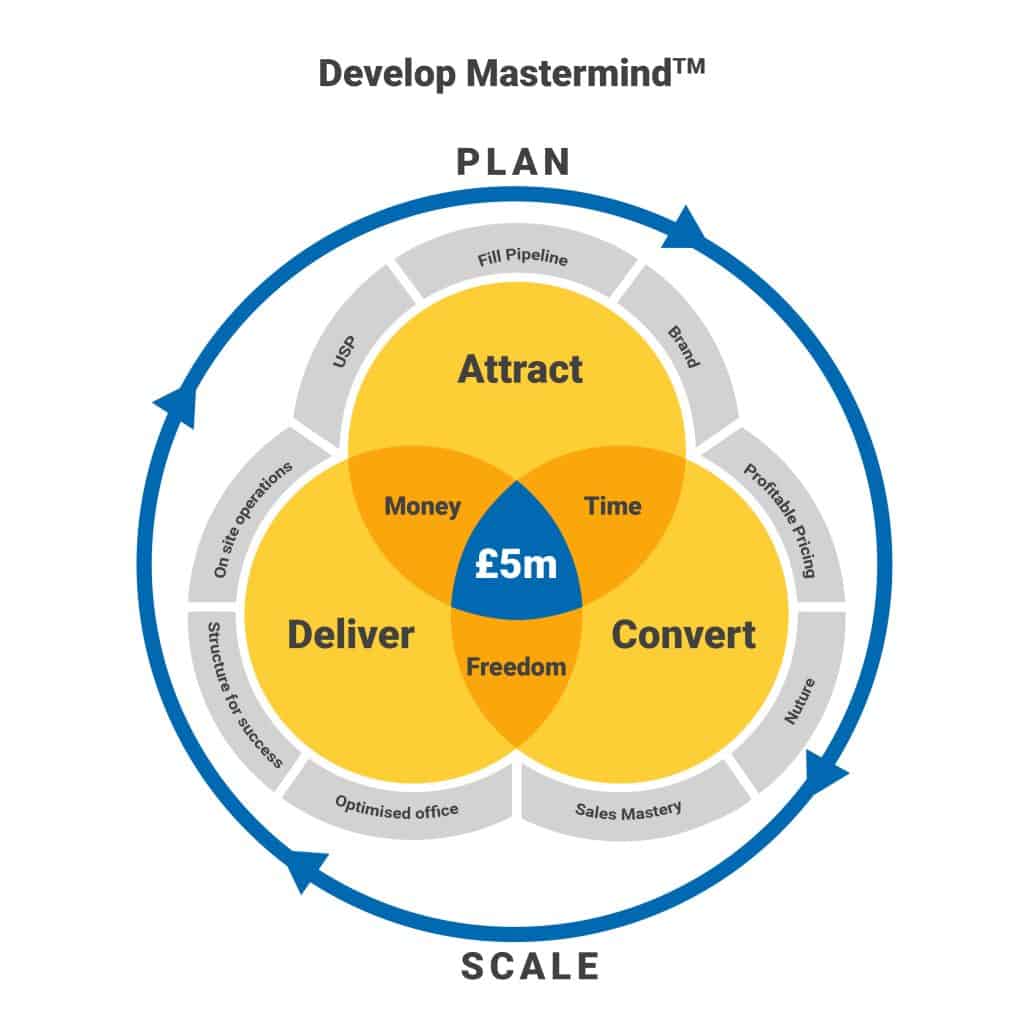
There’s no single approach that works identically for every business. But for a £1M-plus operation looking to scale, the most effective construction company marketing strategy is a hybrid model built on five pillars:
- Brand-Led Positioning: Clear, authentic, and grounded in what you genuinely do well.
- Targeted Outbound: LinkedIn engagement and direct relationship-building with key decision-makers in your target sectors.
- Automated Nurture: Email and SMS sequences that build trust with enquiries over weeks, not days.
- Profit-First Pricing: Quoting with clarity and confidence, not guessing.
- Operational Excellence: Delivering on every promise, so clients refer you without being asked.
Together, these make sure you’re not dependent on one channel. If one lead source dries up, the others keep the pipeline moving. And because you’re positioning on value rather than price, you’re choosing the best work rather than accepting whatever’s available.
Take Control of Your Growth
Scaling your construction business past £1M isn’t about working harder. Most builders reading this are already working too hard. It’s about putting a clear strategy in place: a brand that commands respect, a sales process that converts on your terms, and a delivery system that doesn’t need you present on every site every day.
If you’re ready to stop chasing work and start attracting it, you need a plan built around your business specifically.
Ready to Transform Your Construction Business with Marketing? Click here to download our workbook and book a call with us. Let us help you build the strategy that takes you to £5M and beyond.